Guest blog by Tom Oldham, 2026 SURF Research Placement from the University of Edinburgh
Introduction
Community Councils (CCs) were created through the Local Government (Scotland) Act 1973 to bridge the gap between communities and local authorities. More than half a decade on, they remain unchanged, despite an ever-changing policy landscape and various restructures and reforms. Although they still represent the most local layer of our democracy, CCs have little to no power, receive no substantial funding, and rely exclusively on unpaid volunteers. Moreover, approximately 1 in 5 Scottish CCs are inactive. And while these challenges are well-documented, they are exacerbated by a possible link between activity rates and deprivation, first suggested anecdotally in a Scottish Government survey from 2012.
This research explored, through statistical mapping, whether poorer areas are indeed less likely to have inactive CCs. The activity statuses of the over 1300 CCs in Scotland were manually compiled from council websites, local Facebook groups, and were kindly verified by the Community Council Liaison Officers network, supported by the Improvement Service. The Scottish Index of Multiple Deprivation (SIMD) was used alongside CC boundary areas to determine an overall deprivation score for each CC area. These links were then analysed using logistic regression, and three local authorities were examined as case studies.
Key Takeaways
Deprived areas are more likely to have an inactive CC. The national result was statistically robust (p <.001). For every step down the SIMD decile scale, from 10 (least deprived) to 1 (most deprived), the odds of CC inactivity increase by approximately 40.3%. This trend is shown in the below graph.
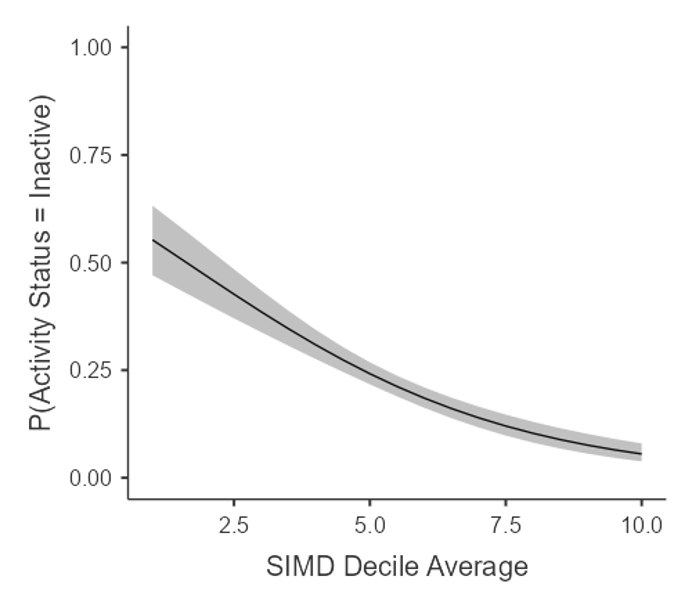
Figure 1: Predicted probability of CC inactivity by SIMD decile average in Scotland
This pattern appears in both rural and urban areas. Six local authorities returned a significant relationship between CC inactivity and deprivation, with a confidence interval below 1. No local authority showed a reliable pattern in the opposite direction. Of these, the City of Edinburgh, Renfrewshire, and North Lanarkshire Council can be described as predominantly urban. Conversely, Perth & Kinross, Dumfries & Galloway, and the Highland Council are either rural or mixed.
In Renfrewshire, all 5 inactive CCs sit within the 9 most deprived CC areas. In North Lanarkshire, 14 of the 20 most deprived CC areas are inactive. It is worth mentioning that virtually all island CCs are active, a trend that would be worth exploring in more detail. It should also be noted that the SIMD is a fairly unrefined tool for assessing deprivation in rural and island locations, which is one of the limitations of using it in those contexts.
A full list of all Local Authorities, with their inactivity rates, is included in Appendix 1 of the full dissertation, pages 47-49.
However, deprivation is only part of the story. Even in the most deprived areas, the probability of an area having an inactive CC is just over 50%. Deprivation therefore only explains a modest share of the overall variation, with many deprived areas having CCs and many affluent areas being without.
Additionally, binary activity and inactivity measures are a blunt tool, as they do not take into account the quality or richness of local engagement, the diversity of participants, or what the community council does or does not achieve locally. Although they do paint a picture of how disadvantage inhibits local democracy, more research can and should seek to understand how this manifests at a local level.
Nevertheless, the fact that there is a relationship between the two is sufficient cause for concern, and should highlight to policymakers the real impact that poverty has not just on life outcomes and communities, but on local democracy.
Institutional support and cooperation make a major difference. East Lothian and Midlothian have no inactive community councils. In East Lothian, CCs sit within Area Partnerships alongside the council and a range of other local groups, giving them real influence. Grouped by ward, Area Partnerships create collective plans for their area, but are also provided with funding. In 2022/2023, £132,000 was directly allocated to CCs in East Lothian, averaging out to £6,600 p.a. per CC. Although still limited, this structure and funding empowers Community Councils, and seems to have an effect on activity rates and local participation.
Midlothian achieves something similar, albeit with less funding. Its Midlothian Federation of Community Councils gives CCs a collective voice and a direct line to the council, is written into the council’s Scheme for Establishment, and sits alongside locally provided training. Shetland, which also has no inactive CCs, has a similar association. Being listened to, supported, and connected matters at least as much as funding does.
Other organisations can fill the gap of a CC, for better or worse. In Dundee, 15 of 18 CCs are inactive. The council also formally recognises 5 Neighbourhood Representative Structures with equal standing and almost identical responsibilities, and at least one CC has stepped aside in their favour. Therefore, CCs have been effectively institutionally replaced by a different form of civic representation, making them less relevant and in turn less attractive to prospective Community Councillors. In Edinburgh, for example, Davidson’s Mains & Silverknowes relies on their gala committee and community association. In Portobello, also in Edinburgh, the development trust Action Porty has taken on many responsibilities that a CC may otherwise handle. An inactive CC does not necessarily translate to an absence of civic life, but these alternatives lack the open, democratic mandate that CCs offer.
What does this mean for hyperlocal democracy in Scotland?
Deprivation has a clear impact on the odds of CC activity, but institutional support and various local factors also play a part. Therefore, deprivation should be a focus when considering CC reform in future. This research also reveals an all too familiar divide between wealthy and deprived areas. Those in the most deprived areas are least likely to have an active CC, and arguably need it the most. Such inequalities must be recognised and addressed—no matter what the outcome of any planned Public Service Reform will be.
It is therefore clear that CCs need institutional support beyond the bare minimum, especially in our most disadvantaged communities. CCs thrive when given real influence, training, a direct line to the council, and the chance to collaborate. Where Development Trusts and other groups are thriving, the aim should be for CCs to work alongside them rather than be displaced by them, so that accessible, democratic participation remains central.
Tom Oldham is an MSc student at the University of Edinburgh, studying International and European Politics. Prior to that, he obtained his BA in Politics and Modern History from the University of Manchester. His full dissertation on the link between poverty and community council inactivity can be read here.
For any questions about this research or SURF’s wider work, please contact Augustijn, SURF’s Policy & Advocacy Manager, at augustijn@surf.scot.